
Herodium (Herodion) National Park – Full Guide

Herodium (Herodion) National Park is a truncated cone-shaped hill near Jerusalem. And besides the palace fortress, you can also visit Herod`s tomb.
Map
Herodium (Herodion) National Park is located 12 kilometers south of Jerusalem, behind the Green Line.
Directions for drivers: Link to Waze and Link to Google Maps
Directions for public transport: Link to Moovit
Interactive map of the area:
Here is the Map of this national park (courtesy of the Israeli Nature and Parks Authority):
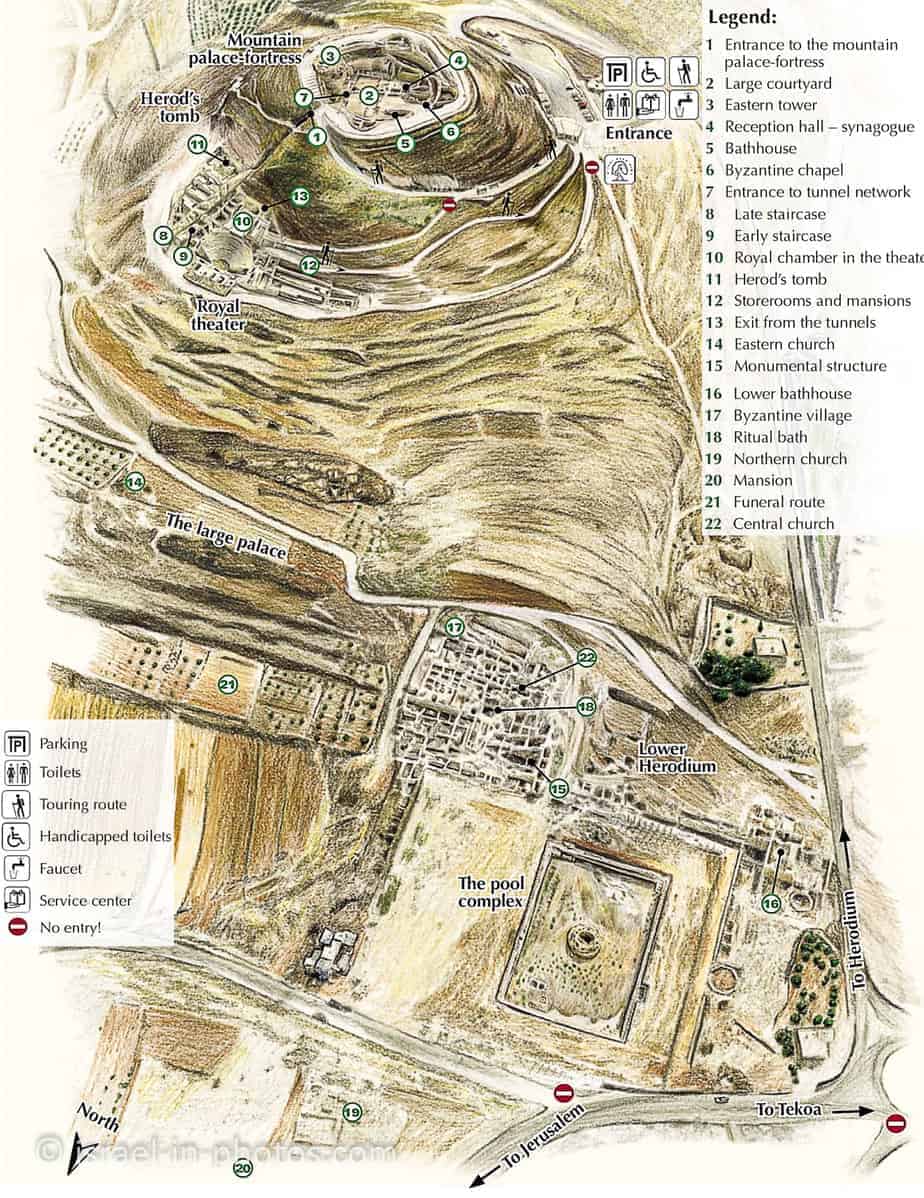
Note: You can click on the map to enlarge it.
Directions
If you drive there, enter “Herodium Park” into Waze or Google Maps. And then recheck the route. Ensure you stick to the main roads and do not enter any Arab villages or cities (for Jews or cars with Israeli plates, I suggest avoiding them to avoid unpleasant situations).
There is a bus station next to Herodion National Park. Bus lines #374 and #366 from Jerusalem stop there. Check out this preset Moovit for additional information. Also, note that you must climb the mountain palace-fortress if you take the bus.
Opening Hours
Sunday – Thursday and Saturday: 8:00 – 17:00 (16:00 in winter).
Friday: 8:00 – 16:00 (15:00 in winter).
On holiday eves, usually 8:00 – 13:00.
Note: Since the pandemic, the Israel Nature and Parks Authority has started limiting the number of people in each park. Thus, reservations are recommended through the official site (you can find the link below).
Entrance Fee
Adult – 31 NIS, child – 16 NIS, and student – 26 NIS. Free for National Parks annual subscribers.
If you visit several National Parks, consider purchasing a combo ticket. For additional information, see National Parks and Nature Reserves.
Note: opening hours and ticket prices were updated in October 2025. In any case, recheck the official site before visiting.
Tours
On a Saturday morning, we joined a free tour (at no extra price beyond the entrance fee). The tours are usually available on weekends, and I would advise joining one. You can always explore on your own after the tour ends.
For additional information about available tours and the languages, contact Herodium Park at 02-5953591, 02-5953592, and gl-erodyon@npa.org.il
Herodion in the Bible
Direct Mentions – Romans 16:11
Herodion is mentioned only once in the Bible in Romans 16:11 (King James Version):
Salute Herodion my kinsman. Greet them that be of the household of Narcissus, which are in the Lord.
What does this mean?
Paul continues to list individuals and families to whom he would like his readers to pass on his greetings. Now Paul mentions a man named Herodion. Since this would have been an unusual name in Rome, scholars suggest this may have been either a family member or former slave who served one of the royal lines of the Herods. Since Paul calls him a kinsman or relative, it is assumed the man is Jewish.
Paul also offers his greetings to those in the Lord who belong to the family of a man called Narcissus. Paul does not offer greetings to Narcissus directly. In other words, Paul offers his greeting to the Christian members of this man’s family, suggesting that some in the family had not come to faith in Christ. This may be the same Narcissus known from history as a servant to the Roman Emperor Claudius. Claudius died in AD 54. Narcissus is said to have committed suicide sometime later.
Source: bibleref.com
Indirect Mentions
King Herod is also mentioned. And according to the verse in Matthew, when Herod heard the prophecy of the birth of a new King of the Jews (a direct threat to his position), he acted. Since he did not know who would replace him, he ordered the killing of the newborn babies in Bethlehem.
However, the historical evidence for the massacre of the innocents is only Biblical, and only one verse in Matthew mentions it (absent from the other gospels).
Pontius Pilate is also mentioned in the Bible. Pontius Pilate was the Roman prefect (governor) of Judea. And he was the official who presided over the trial of Jesus and ordered his crucifixion.
Recently, a Pilatus ring was found at Herodium. Though scholars debate whether this ring belonged to Pontius Pilate or to someone in his administration, the find itself is interesting.
You can find out more about the ring here. And you can see the Pontius Pilate Inscription at Caesarea National Park.
King Herod
Herod was born in 74 BCE to an influential family of Idumean origin. During the Hasmonean period, many Idumeans converted to Judaism and entered the service of the kingdom. Herod’s grandfather, Antipas, was governor of Idumea under the Hasmonean king Alexander Jannaeus. Herod’s father, Antipater, was an adviser to John Hyrcanus II. Much of what we know of Herod’s life comes from the writings of the Jewish historian Josephus Flavius.
In 47 BCE, Herod was appointed ruler of the Galilee, and in that same year, he married the first of his ten wives. After the Sanhedrin tried him for executing Jewish rebels in Galilee, he was forced to flee. But under the aegis of the Romans, he conquered the rest of the country and, in 37 BCE, became king of Judea, which he governed until he died in 4 BCE. Herod, whose reign marked the end of the Hasmonean dynasty, ruled under Roman auspices but with a great deal of autonomy.
Note: Unless stated otherwise, all quotes were taken from the official site.
Herod, The Builder
He was famed for his grandiose building projects in the Land of Israel and beyond – including the rebuilding of the Temple and the expansion of the Temple Mount Esplanade. In addition to founding cities like Caesarea and Samaria, he built the port at Caesarea, as well as palaces, temples, gardens, and water systems, and strengthened desert fortresses. The king’s construction projects revealed his vision and organizational skills, while his use of new techniques and technologies, such as concrete, led his architectural achievements to new heights. No wonder Pliny the Elder described Herod’s Jerusalem as the most famous city in the East. Judea prospered during Herod’s reign. However, his descendants could not stabilize their rule after his death, and Judea became a Roman province. This period led to the Great Revolt and the destruction of the Temple and Jerusalem.
Note: check out Caesarea National Park for additional info.
History
In 40 BCE, Herod was forced to flee Jerusalem from Antigonus Mattathias, the last of the Hasmonean kings. Antigonus had allied with the Parthians (the empire that blocked the Romans from the East) against the Romans – Herod’s patrons. At that time, the Parthians controlled the region of Syria, which also included Jerusalem, and appointed Antigonus as ruler of Judah, so Herod was forced to flee from Jerusalem. Antigonus and his allies pursued him, catching up with him east of Bethlehem. Herod escaped with great difficulty. He left his family behind at Masada and set out for Rome, where the Romans appointed him king of Judah.
The Construction Of Herodium
Herod returned to Judah, defeated Antigonus Mattathias, and became king of Judah. The memory of this desperate battle stayed with him, and in around 28 BCE, he began to build Herodium, naming it after himself. Herod moved the Beth Tzur district administration to Herodium and brought water to the site from Solomon’s Pools in Jerusalem, some 6 km. At Herodium, he built himself a tomb estate where, according to Joseph ben Matityahu (Josephus Flavius), he was buried.
In the Great Revolt (66 CE), the rebels seized Herodium and entrenched themselves there. Some six months after the destruction of the Temple, the Romans set out to capture the peripheral areas of Judah from the Zealots. Apparently, due to its proximity to Jerusalem, Herodium was their first target. According to Josephus Flavius, the Roman historian, Herodium surrendered but finds indicate otherwise. For example, we know that the entry gate to the upper palace was burned and that the fire spread to underground areas, causing considerable damage. During the Bar Kokhba Revolt (132 – 135/6 CE), Mt Herod also served as a base for the rebels, and they left behind them, among other things, secret tunnels and caves carved in the rock.
During the Byzantine period (4th – 7th centuries CE), a large village with three churches was built in Lower Herodium, over the remains from Herod’s time. A chapel was built in the fortress at the top of the mountain.
At Herodium National Park
Note: We visited Herodium National Park back in 2008. Herodium is still an active archaeological site, and, for example, Herod’s tomb was discovered only in 2007 (and during our visit, we could not see it). Thus, though we will go through all the main points of interest, there are no photos of them.
We started our visit at the top of the human-made mountain with the palace-fortress. While there, you will be able to see several points of interest.
Mount Herod
Mount Herod, the human-made mountain – the steep slopes surround the “crater” in which Herod built the Herodium complex. Herod turned the hill into a prominent cone, a kind of giant monument. In the outer wall of the hill, a passageway was found, serving as an entry to the hill, with a great flight of stairs leading to it. The mountain was built of layers of earth and small stones. The observation point at the top of the conical mountain offers a view of the crater within and the two fortification walls surrounding the crater in two circles. The crater was originally a building rising five stories above the courtyard level (25 meters). The circumference of the outer wall is 150 m.
Here are several images of Herod’s Palace and its surroundings:
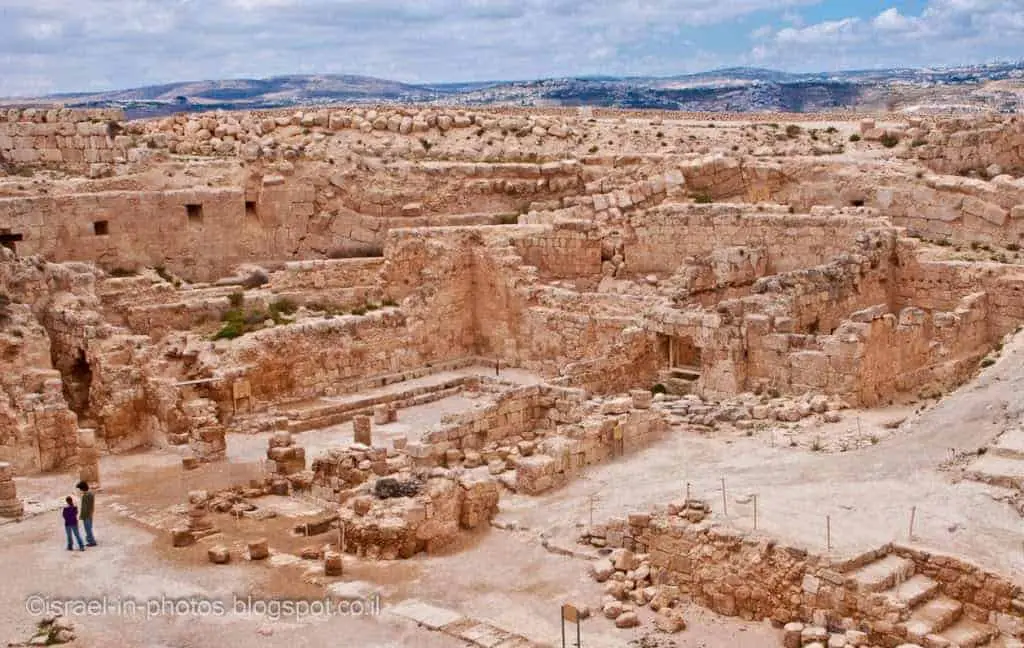
Earth was heaped up around the walls, which created a cone-shaped artificial mountain. At its foot, Herod built a kind of royal ‘country club,’ including a large pool, a bathhouse, and a roofed pool.
Despite its desert location, the complex was surrounded by magnificent gardens watered by the pool. A unique aqueduct from the area of Solomon’s Pools near Bethlehem brought water to the palace.
Herod’s Palace was the starting point of our tour. The guide started with explanations about Herod, the builder, and Herod’s Palace.
Herodium Fortress – Herod’s Palace
Herod himself commissioned a lavish palace to be built between 23 and 15 BCE atop Herodium for all to see. The palace itself consisted of four towers of seven stories, a bathhouse, courtyards, a Roman theatre, banquet rooms, a large walkway (“the course”), and extravagant living quarters for himself and guests. Once Herod died and the Great Revolt started, Herodium was abandoned. The Jews eventually had a base at Herodium where they built a synagogue which can still be seen today, unlike much of Herod’s Palace.
Source: Wikipedia

The Palace is a square building encompassed by a circular wall. The palace included an ornamental garden surrounded by a colonnaded peristyle, a bathhouse, several living rooms, and a reception and banqueting hall. The palace walls were decorated with frescoes depicting geometric patterns. The bathhouse was built following Roman bathing rules and had an apodyterium (an entrance lobby and dressing room), a caldarium (hot room), a circular tepidarium (warm room), and a frigidarium (cold room) with a small bathing pool. The hot air came up from the double floor through channels carved in the walls. In the warm room, an impressive stone dome has survived in its entirety, the oldest of its kind in Israel.
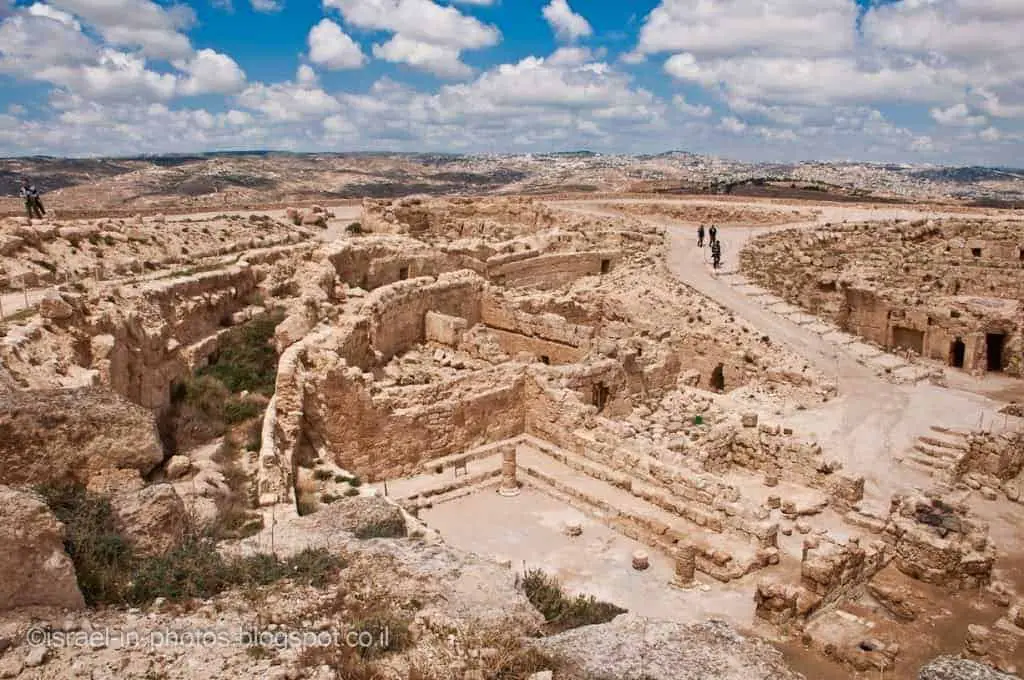
Synagogue
The remains of a rectangular building at the bottom of the photo above are from a synagogue built by rebels during the Great Revolt.
The original ceiling of the room was replaced by a light ceiling, supported by four columns that were not there originally. Outside the entrance to the hall, a small room was used as a purification pool. Another mikveh dating to the Great Revolt was found in the courtyard’s center, close to the east tower. This mikveh contained a small pool, and alongside it was a water storage tank.


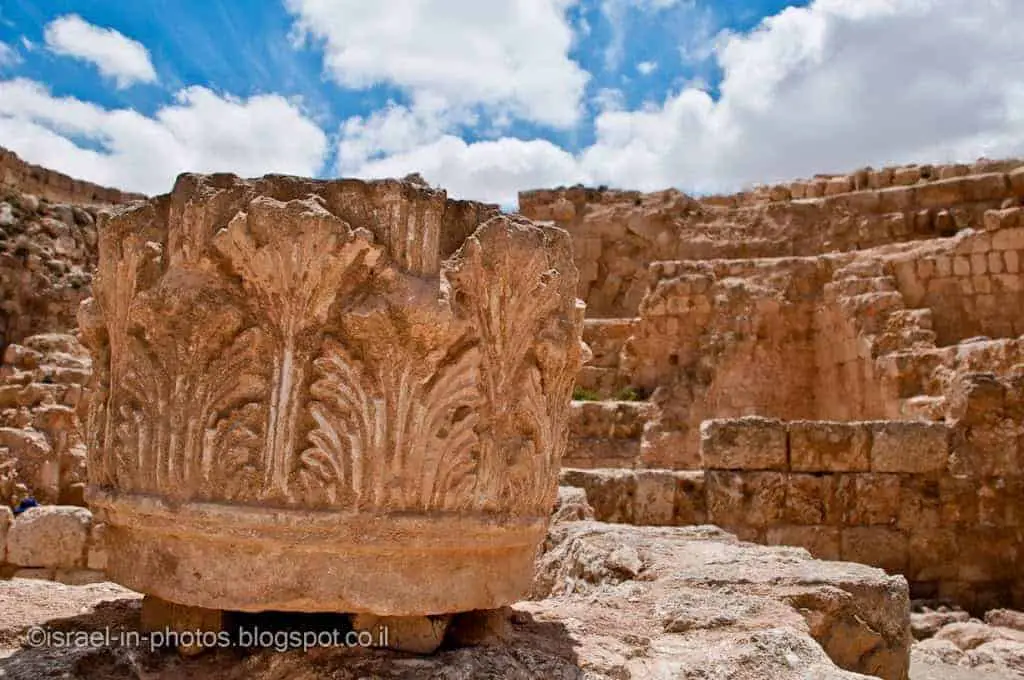


After getting explanations about the site, our guide took us through ancient tunnels.
Underground Systems
Beneath the hilltop fortified palace, three systems were found:
- Four Herodian water cisterns.
- The remains of a tunnel from the time of the Great Revolt. The tunnel was intended to bring water up from the lower systems to the fortified palace without being visible to the Romans besieging the place.
- Bar Kokhba