Old Jaffa – Full Visitors Guide with Photos

Old Jaffa is one of the oldest port cities in the Mediterranean basin. And by visiting the city’s streets, you can see its rich history.
Notes:
- Today Jaffa is a modern town, and most of its tourist attractions are located within or near the old city. Therefore, in this guide, I will concentrate on Old Jaffa.
- This post focuses on Old Jaffa. If you want to see other places in Jaffa, check out Jaffa Port and Jaffa Flea Market.
- I have visited Old Jaffa many times, and this combined post is the result. Thus, you will see photos taken during different times and seasons.
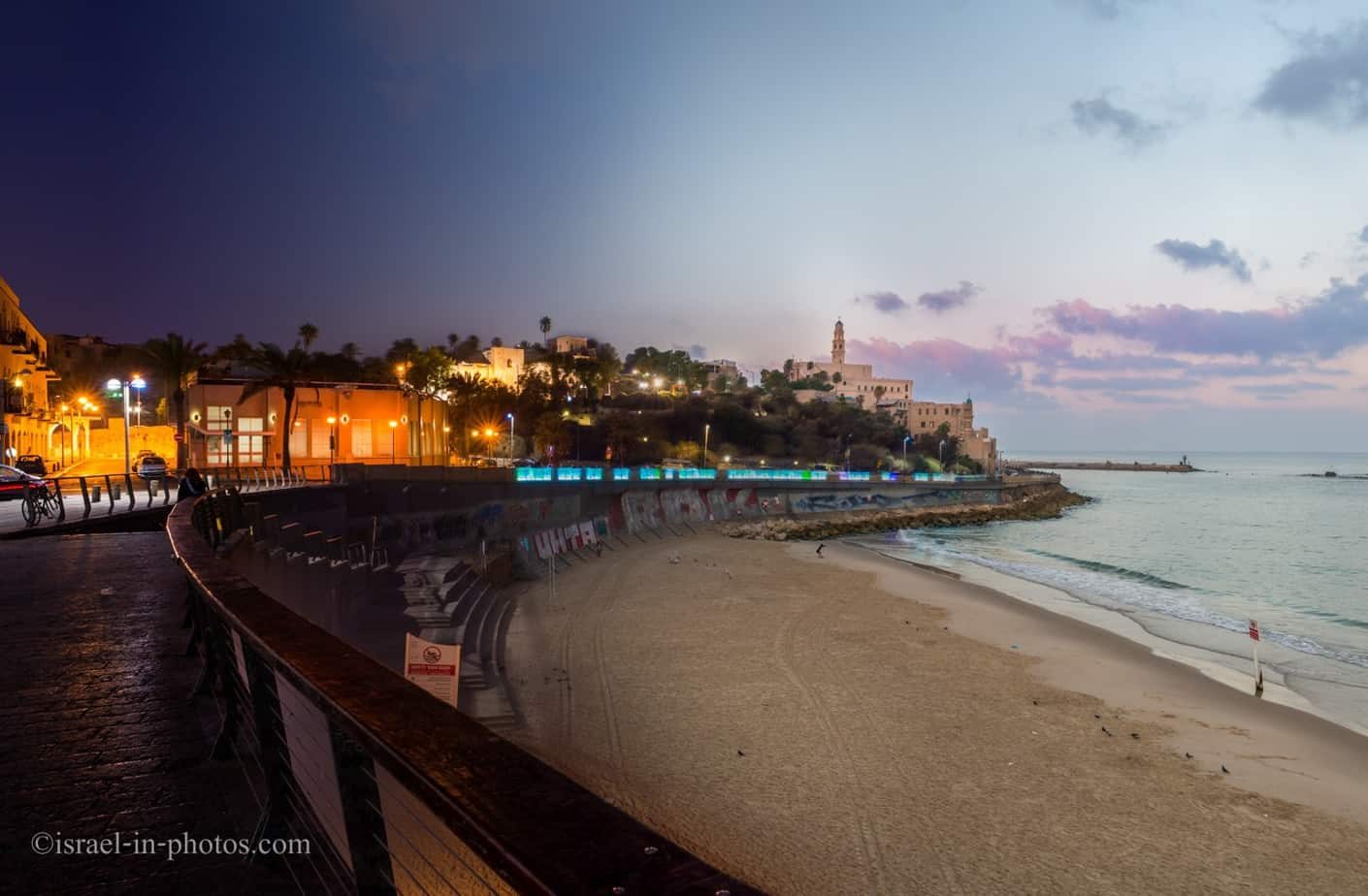
- The featured Jaffa image belongs to the “From Day To Night” series. In that series, I took and merged several photos of the same scene at different times of the day. To find out more, check out: From Day to Night in Israel.
Map
Directions for drivers: Link to Waze and Link to Google Maps
Directions for public transport: Link to Moovit
Interactive map of the area:
And here is the map of attractions in Old Jaffa:
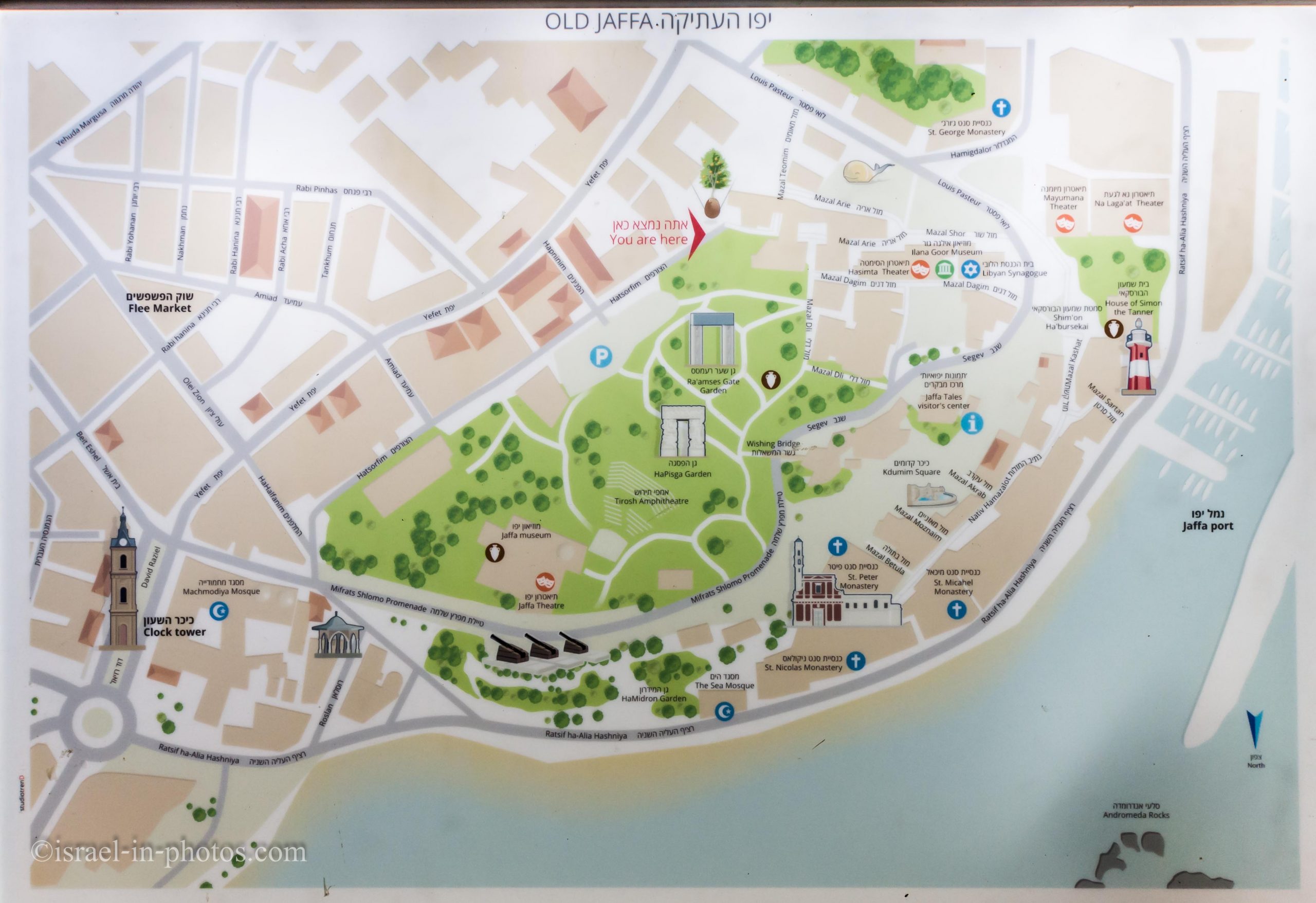
Note: you can click on the map to enlarge it.
Directions
If you visit Tel Aviv, especially the beach, you can probably walk there (from most Tel Aviv beaches, you can see Jaffa). Today Tel-Aviv and Jaffa are under a single municipality. That means you can combine a visit to Jaffa with a walk in one of the nearby Tel-Aviv neighborhoods. For suggestions, check out Tel Aviv-Yafo.
You can also reach Jaffa by public transport. Various buses go through Yerushalayim Avenue, and some even get to the Clock Tower. The bus line number depends on your location. You can use Moovit to find the exact route.
Parking
Finding free parking in this area is a challenging task. But, if you arrive early, you can try Zelda Shne’orson Mishovski Street and Elisabeth Bergner Street (opposite the fuel station). Another better option would be the Jaffa Port parking (Nemal Yafo 24). It is a big free parking lot near the port. When it comes to paid parking, there is a variety of options. And the Old Train Station parking (HaMered Street 65) is the most popular one. It is beneficial if you are planning to visit the Neve Tzedek neighborhood.
Tours
A typical visit to Jaffa will take 2 – 5 hours. If you are short on time, want to make the most of a two-hour visit, or love to learn new things, you can join a tour. Since Jaffa is a popular touristic spot, you can find many different tours. When I searched for free tours (I read somewhere there are such), I stumbled upon SANDEMANs NEW Europe free Jaffa tour. I have not joined one of their tours, so I cannot tell you about my experience. But I saw many positive reviews online. Also, I should mention that these are tips-based tours. Meaning they expect a tip at the end of the tour. Recently I read an article that said the average tip for a free tour in Europe is 10 Euro.
Also, see the Bein Harim offer above.
In any case, it is worth keeping in mind that there is such an option.
What Does Jaffa Mean?
Mythology says that Jaffa is named for Yafet, one of the sons of Noah, the one who built it after the Flood. The Hellenist tradition links the name to Iopeia, or Cassiopeia, the mother of Andromeda. An outcropping of rocks near the harbor is reputed to have been the place where Perseus rescued Andromeda. Pliny the Elder associated the name with Iopa, daughter of Aeolus, the god of the wind. The medieval Arab geographer al-Muqaddasi referred to it as Yaffa.
Source: Wikipedia
Jaffa in The Bible
Jaffa is mentioned four times in the Hebrew Bible. As a city opposite the territory given to the Hebrew Tribe of Dan (Joshua 19:46), as port-of-entry for the cedars of Lebanon for Solomon’s Temple (2 Chronicles 2:16), as the place whence the prophet Jonah embarked for Tarshish (Jonah 1:3) and again as port-of-entry for the cedars of Lebanon for the Second Temple of Jerusalem (Ezra 3:7).
Book of Joshua mentions the city as the territorial border of the Tribe of Dan, hence the modern term “Gush Dan” for the center of the coastal plain. The tribe of Dan did not manage to dislocate the Philistines from Jaffa, but many descendants of Dan lived along the coast and earned their living from ship making and sailing. In the “Song of Deborah,” the prophetess asks: “Why doth Dan dwell in ships?”
After Canaanite and Philistine dominion, King David and his son King Solomon conquered Jaffa and used its port to bring the cedars used in the construction of the First Temple from Tyre.
The city remained in Israelite hands even after the split of the United Kingdom of Israel.
Source: Wikipedia
History
I will not go through history in this section but only mention several vital facts.
Ancient Jaffa was built on a 40 meters high ridge, with a broad view of the coastline, giving it a strategic importance in military history. The Tel of Jaffa, created through the accumulation of debris and landfill over the centuries, made the hill even higher.
Archaeological evidence shows that the site of Jaffa was inhabited around 7500 BCE.
The natural harbor of Jaffa has been in use since the Bronze Age.
The city as such was established at the latest around 1800 BCE.
Source: Wikipedia

As you can see, Jaffa is one of the ancient port cities in Israel and the Mediterranean basin. And by looking at this view of Jaffa, you can see two reasons for this spot becoming a port.
The closeness to the sea is apparent, but Jaffa is on a hill. Most places in this area close to the sea are at sea level. A mountain makes it easier to defend the city. And another reason is water. In ancient times there was a river on the other side of the Tel, which supplied the town with water.
Mythology
The photo above shows a group of rocks to the right. I know it is hard to see, but a flag is on one of the rocks. That is the Andromeda rock. According to Greek mythology, it is the rock to which beautiful Andromeda was chained.
In Greek mythology, Andromeda is the daughter of the Aethiopian king Cepheus and his wife, Cassiopeia. When Cassiopeia’s hubris leads her to boast that Andromeda is more beautiful than the Nereids, Poseidon sends the sea monster Cetus to ravage Andromeda as divine punishment. Andromeda is chained to a rock as a sacrifice to sate the monster but is saved from death by Perseus.
Her name is the Latinized form of the Greek Ἀνδρομέδα (Androméda) or Ἀνδρομέδη (Andromédē): “ruler of men”, from ἀνήρ, ἀνδρός (anēr, andrós) “man”, and medon, “ruler”.
Source: Wikipedia

Tel Jaffa
We will start with a visit to Tel Jaffa. This forty meters high ridge not only allows excellent views, but you can see some of the most popular attractions there.
Note: if you are interested in the meaning of the word Tel (mound), you can find an elaborate explanation at Megiddo National Park.
Sabil Abu Nabut B
Before climbing Tel Jaffa, let’s make a short stop at 13 Russlan Street in Jaffa.
What is a Sebil?
A sebil or sabil is a small kiosk in the Islamic architectural tradition where water is freely dispensed to members of the public by an attendant behind a grilled window. The term is sometimes also used to refer to simple unmanned fountains with a tap for drinking water, though other names often exist for such fountains (such as çesme in Turkish).
Source: Wikipedia
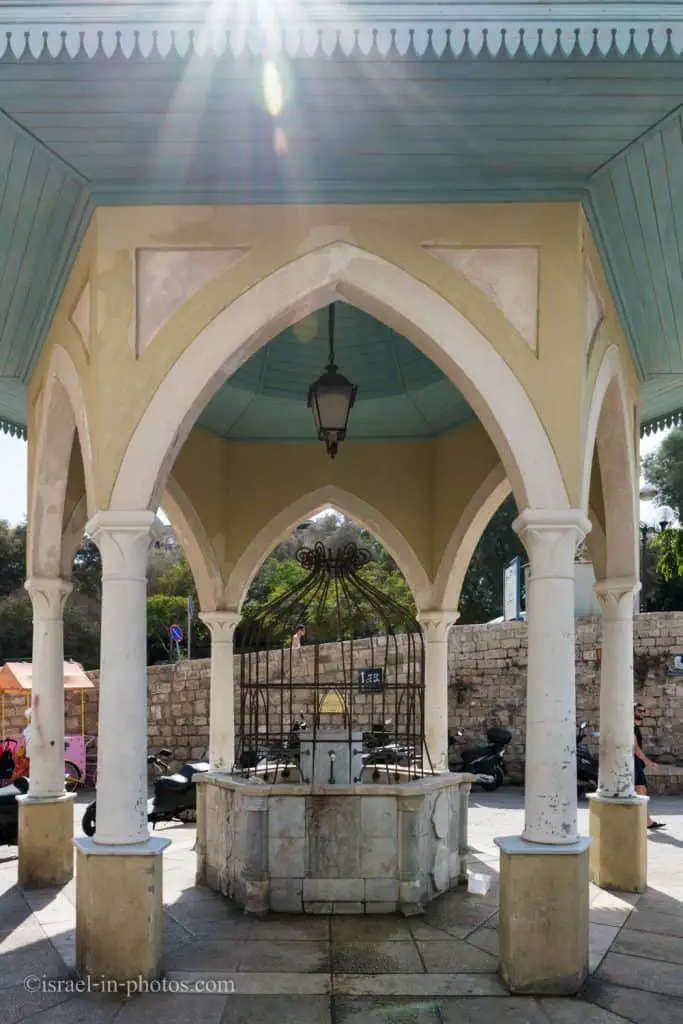
Sabil Abu Nabut B was built in the early 19th century by the Jaffa governor known as Abu Nabut, and it is located near the Mahmoudiya Mosque. There was a magnificent building above the Sabil. But it was destroyed under unclear circumstances. Nonetheless, the Sabil itself survived. And when a new road was constructed, it was moved twenty meters to the west.
In 2011, the restoration and preservation of Sabil Abu Nabut B were started. The recovery was made according to 19th-century paintings, and inside the Sabil, water taps were installed for the general public.
Note: this Sabil is called Abu Nabut B since there is also Sabil Abu Nabbut. Sabil Abu Nabbut, also known as Tabitha’s Well, is located on Zvi Herman Segal Street in Tel Aviv, near the Russian Orthodox Church In Abu Kabir. It was built in 1820/21 CE during the Ottoman period, and its primary purpose was to facilitate the journey between Jaffa and Jerusalem.
Mahmoudiya Mosque
On 7 Ruslan Street, near Sabil Abu Nabut B, you can find the entrance to Mahmoudiya Mosque. The mosque was built during the 19 century by Muhammad Aga a-Shami (nicknamed Abu Nabut), governor of Jaffa, on behalf of the Ottomans.
On the southern exterior wall of the Mahmoudia Mosque on Tayelet Mifraz Shlomo Street, you can find another Sabil. It is named Sabil Suleiman after Suleiman Pasha, the Acre ruler who appointed Abu Nabout as governor. The Sabil was built in the form of a large arch that combines white marble stones and pink granite. This Sabil was outside the city and served people who entered the city gate.
And now, let’s climb Old Jaffa along Tayelet Mifraz Shlomo Street.

After climbing almost to the top of the hill, you find several viewpoints. This one presents several cannons and the Tel Aviv coastline.
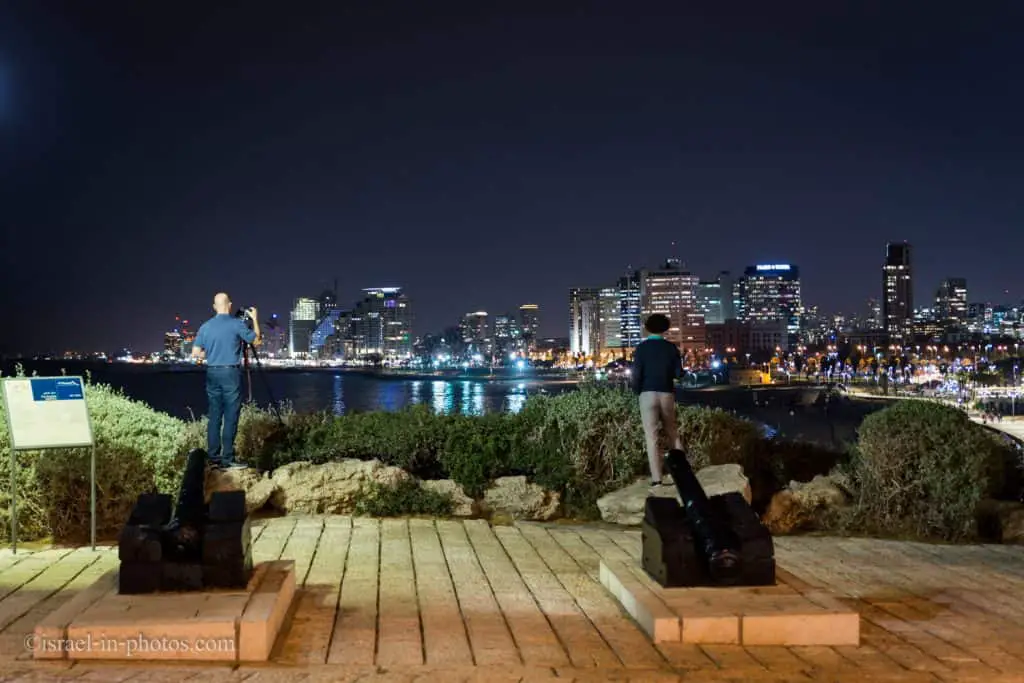
There are additional cannons around old Jaffa, and they serve as a reminder of the time Napoleon conquered the city.
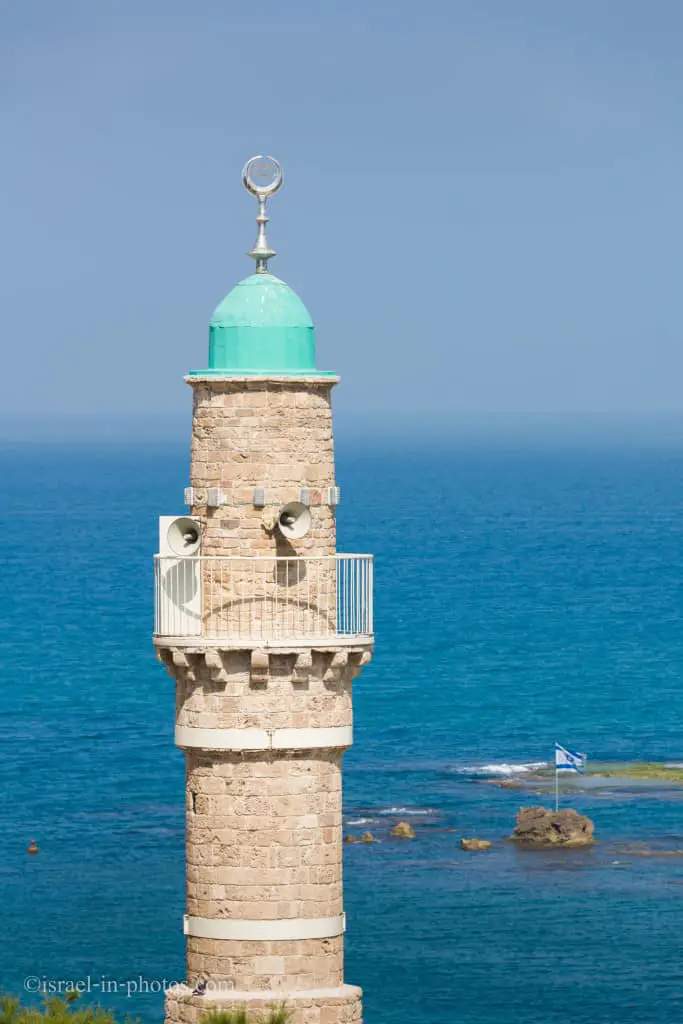
And after a short walk, we reached Saint Peter’s Church.
Saint Peter’s Church
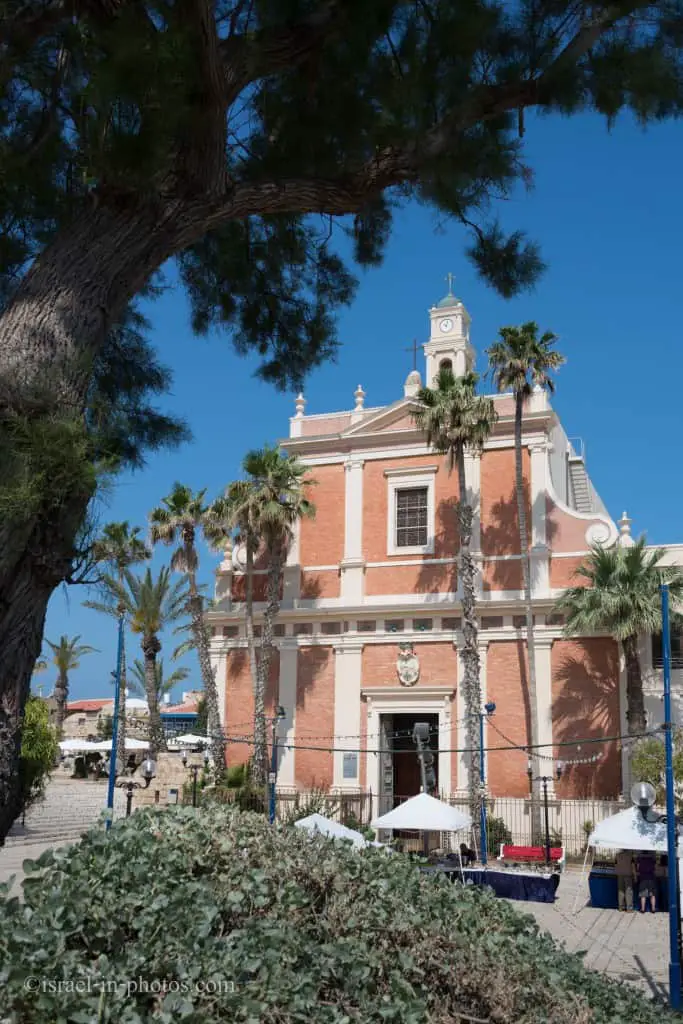
There is usually a small market in front of Saint Peter’s Church. In those stands, you can find primarily souvenirs and handmade jewelry.
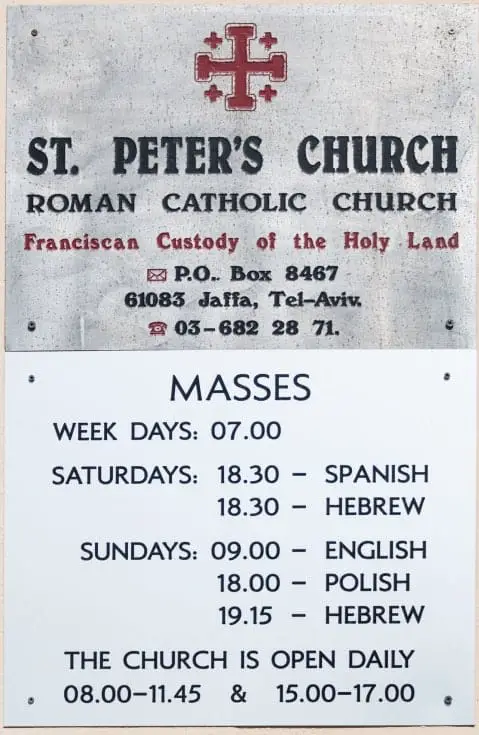
Saint Peter’s Church sits at the top of the Jaffa Mound, at a strategic spot, and has served as a Christian center for thousands of years. Underneath the church and to its side are the remnants of a crusader fort, underneath which a Byzantine church is buried. The fort was part of the city citadel during the reign of Louis IX, king of France. In the church’s courtyard stands the statue of Louis IX, who was canonized in Christian tradition for his part in the crusades.
According to accepted history, the church also hosted the French general Napoleon when he stayed in Jaffa during his campaign in Israel in 1799.
The church is vast and is noted for its splendor. It was constructed at the beginning of the 20th century in the Baroque style, with a long nave and a vaulted ceiling. As opposed to most churches which face east, Saint Peter’s faces west, towards the sea, where Peter’s famous dream took place, and towards Rome, where he was sent later.
The walls of the church are decorated with oil paintings depicting the Fourteen Stations of the Cross and Saint George fighting the dragon. Over the altar is a depiction of Peter’s visitation in a dream by the angel Michael.
Note: unless stated otherwise, all quotes were taken from the Official Site.