
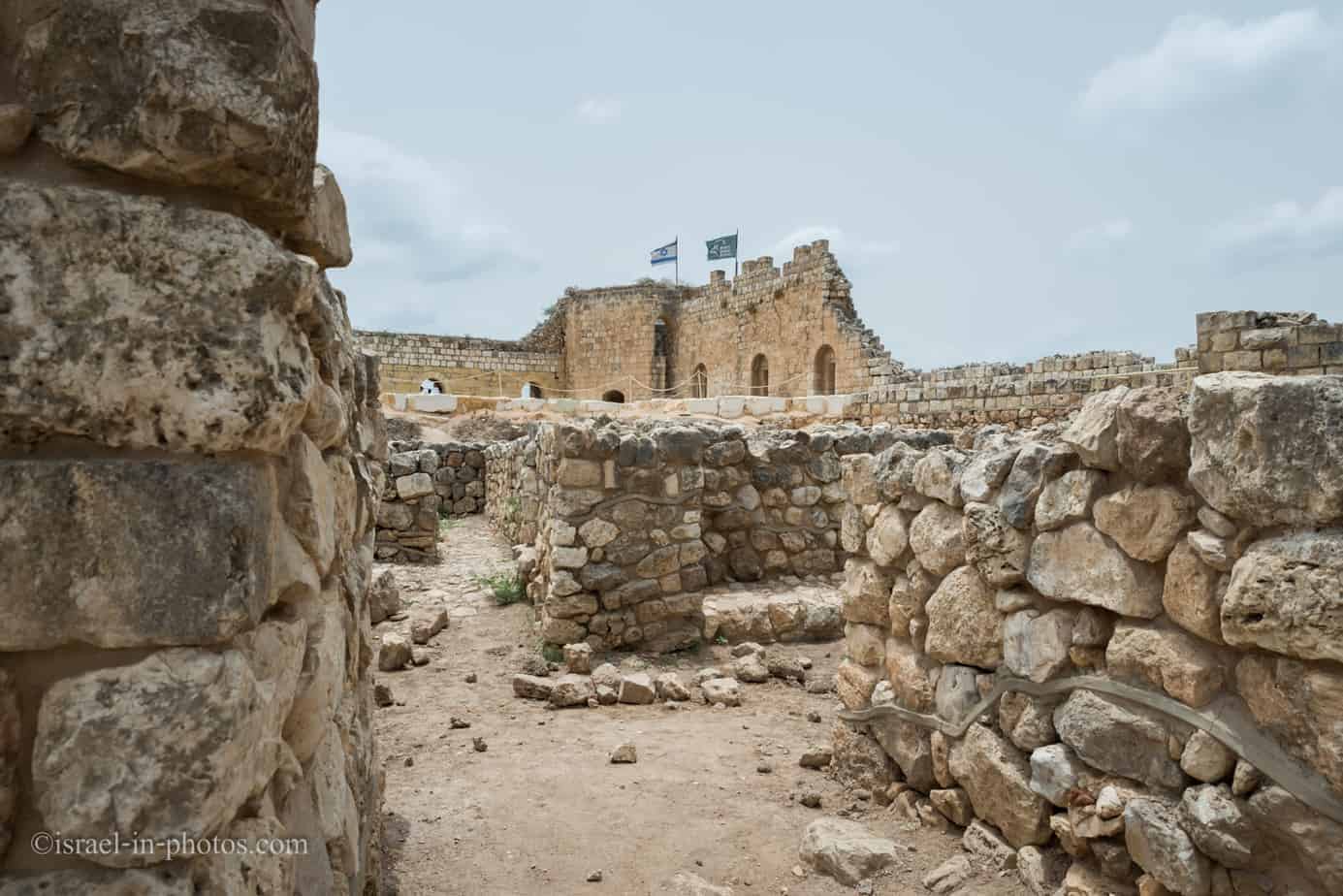
Yarkon National Park – Tel Afek (Antipatris) Compound – Visitors Guide

Tel Afek compound at Yarkon National Park has the Antipatris fort, an artificial lake, paddling pools, and a large picnic area.
Note: This article contains information about Afek. If you are interested in the other Yarkon National Park compound, check out Yarkon Springs.
Map
Yarkon National Park is in central Israel between Petah Tikva and Rosh Haayin.
Directions for drivers: Link to Waze and Link to Google Maps
Directions for public transport: Link to Moovit
Interactive map of the area:
Yarkon National Park has two compounds with two separate entrances. I marked both regions on the map above, and you can also see them on the following map.

Note: you can click on the map to enlarge it.
On the right side of the map, you can find Tel Afek. You will see Antipatris Fort, the British water pumping station, the artificial lake, paddling pools, and other points of interest.
And on the left side of the map, you can find the Yarkon Springs area. You can walk along the Yarkon River in this region and see the Yarkon bream pool, Al-Mir flour mill, and several other places. Also, the camping area is situated in the Yarkon Springs area.
No road inside the park connects Tel Afek and the Yarkon Springs area. There is only a hiking trail between the two parts of the park. That means that you have to choose in advance where to park your car and hike from there. If you want to drive from one part of the park to another, you must exit and drive around the national park.
Trails at Yarkon National Park
There are several options for hikes. The first two options would be a short hike in each area (about half an hour to an hour). You can also extend these hikes by visiting the Water-Lilly Ponds in the middle of the map (marked as #6 on the map above). Then, a typical hike will take about one and a half to two hours. And the longest walk includes visiting both areas. If you have a car parked in each region, it will take about two hours. Otherwise, you must return to the initial point, a four-hour walk.
Note: sometimes, the gates that allow hiking from one park’s compound to another are closed. Thus, if you plan to walk from one area to another, contact the Israel Nature and Parks Authority in advance.
Directions
As mentioned above, you must choose in advance whether to park at Tel Afek or the Yarkon Springs area. There are two separate entrances, and they are not close to each other.
You can reach the entry to Tel Afek from road #483 or use the links above the interactive map.
Note: there are many parking spaces inside each section of the park.
Opening Hours
Sunday – Thursday and Saturday: 8:00 – 17:00 (16:00 in winter).
Friday: 8:00 – 16:00 (15:00 in winter).
On holiday eves, usually 8:00 – 13:00.
Note: Since the pandemic, the Israel Nature and Parks Authority has started limiting the number of people in each park. Thus, reservations are recommended through the official site (you can find the link below).
Entrance Fee
Adult – 28 NIS, child – 14 NIS, and student – 24 NIS. Free for National Parks annual subscribers.
If you visit several National Parks, consider purchasing a combo ticket. For additional information, see National Parks and Nature Reserves.
Note: the entry ticket is valid for both areas on the same day.
Note: opening hours and entrance fees were updated in April 2024. In any case, recheck the official site before visiting.
Why was Afek important? And what does Afek mean?
In the past, it was not possible to pass from the southern coastal plain towards the Sharon and northwards due to the marshes that had developed around the river. The ancient Via Maris that traversed the country lengthwise had to circumvent the marshes from the east, which is why the region was called the “Afek Passage.” The route went along a pass between the mountain and the sources of the Yarkon. Already from ancient times, this passage was a focus for human settlement, which is evidenced by the remains of a settlement at Tel Afek.
The area was settled continuously for 5,000 years, from the beginning of the Bronze Age until the Ottoman period. In the later Roman period (2nd-4th centuries CE), Antipatris was the major city in the region and an important junction in the system of roads built by the Roman rulers in Palestine. Antipatris (and Mirabel at Rosh Ha’Ayin) commanded the Afek Passage, the Yarkon basin, and the Southern Sharon. The name “Afek” derives from the Akkadian word “Aphek”/Aphekum,” meaning springs, which also appears to be connected to the Hebrew word “Afek” – riverbed, stream.
Note: unless stated otherwise, all quotes were taken from the official site.
The Squill Trail at Tel Afek
We will visit Tel Afek using the Squill trail. It is an easy loop walking path about two km long and takes around an hour.
The Squill trail – a walking route along which squills (Drimia Maritima) were planted in 2011. The inspiration for selecting squill to mark the trail came from the ancient practice of using the plant as boundaries between fields. The Squill Trail is a circular route passing through sites from the Roman, Ottoman, and British periods.
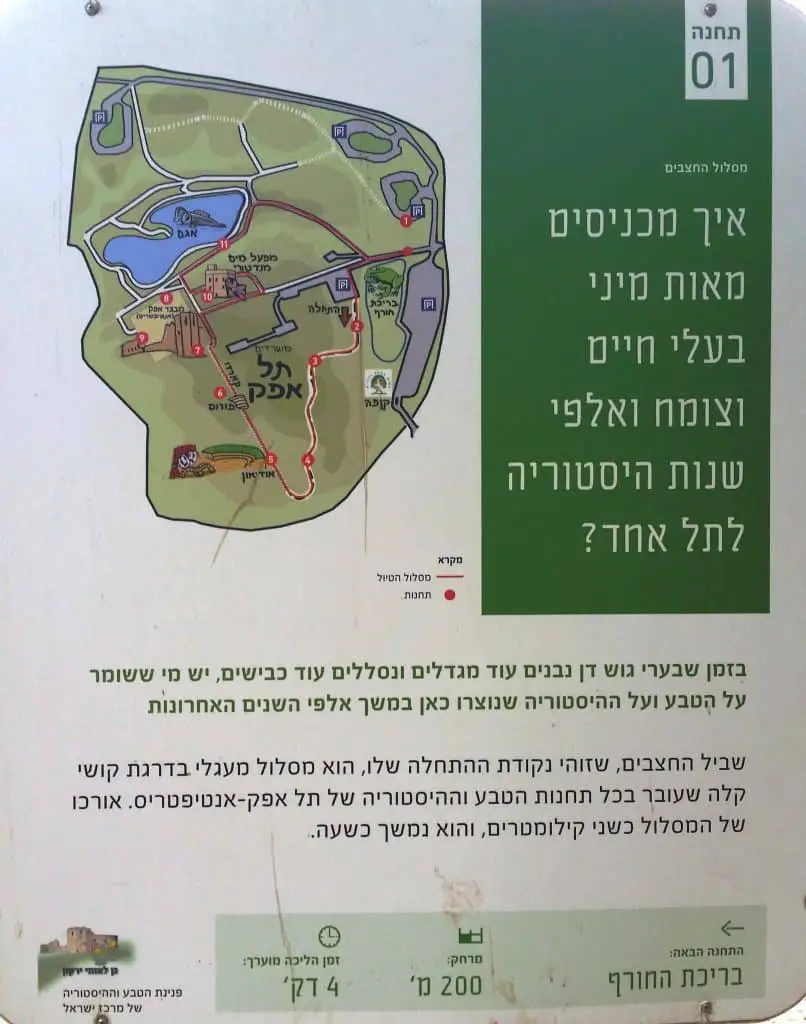
The Squill trail starts at the parking near the winter pool (marked as #1 on the map).


Along the Squill trail, you can find different informational signs in Hebrew.

And after about ten minutes, you will reach Cardo.
The Roman Cardo
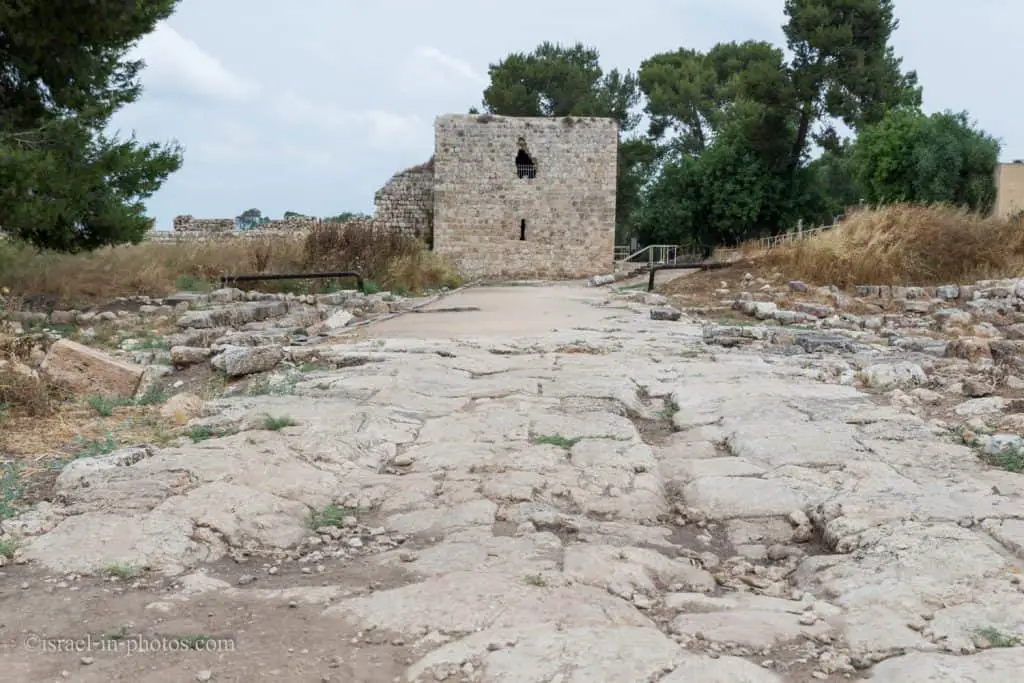
It was the main street of the Roman city of Antipatris. You can see grooves on the paving stones carved by carriages.

At the far end of the Cardo, you can see a lookout tower. That is Antipatris Fort, and we will reach it shortly. But meanwhile, let’s visit the theater.

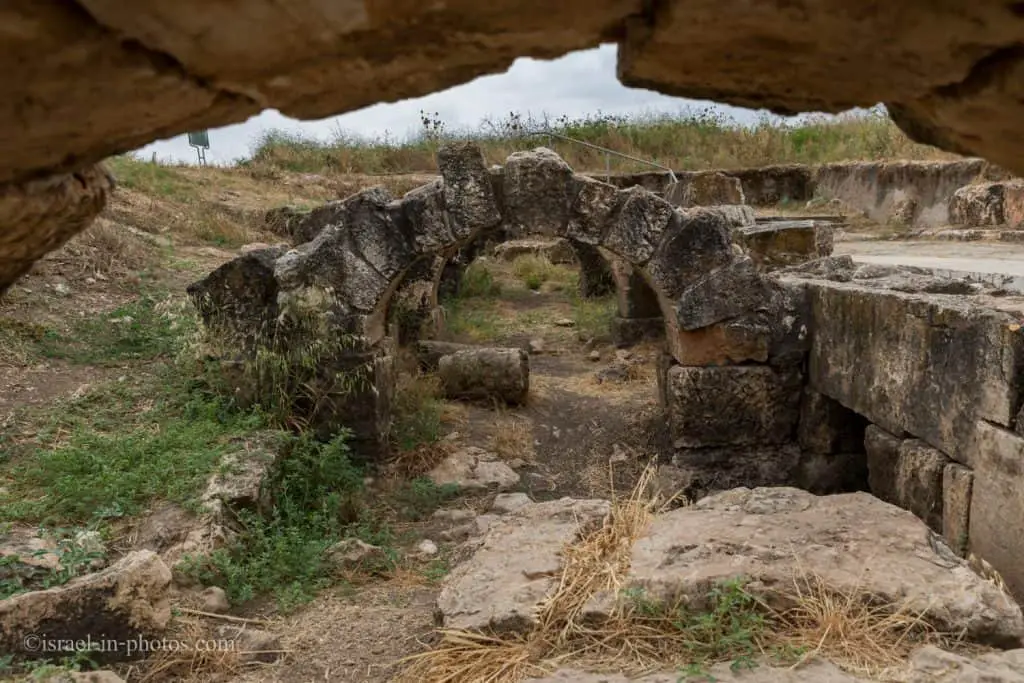
The Roman Theater
The Roman city Antipatris used the Cardo and the Roman Theater at the beginning of the first century.

Alexandroni Brigade Memorial
Shortly after the theater, you will see a sign for the Alexandroni Brigade memorial.
Forty-one soldiers from the Alexandroni brigade died in this region during the independence war.

Antipatris
We will continue along the Cardo until we reach the Antipatris Fort (marked as #3 on the map at the beginning of this post).
You will see the word “Tel” many times in this post. Tel is an artificial mound that was created by building one city on top of another over and over again. You can find more information about Tel at Tel Megiddo National Park.
Archeological excavations at Tel Afeq exposed many layers from the fourth millennium BCE until the 20th century. In the Second Temple period, Herod built the city of Antipatris. And the remains of the fortress you can see today are the Ottoman fort called “Head of the Spring.”
The City of Antipatris
Short overview of Antipatris:
Antipatris was one of the most important cities in Israel; it was settled almost continuously for 5,000 years, from the early Bronze Age to the Ottoman period, and achieved a size of over 120 dunams. Its importance derives from its location at the “Afek Passage” – the narrow passage that connects the hills of Samaria and the sources of the Yarkon River. This passage served to circumvent the marshy area and was part of the Via Maris, which traversed the length of the country.
At the top of the Tel the ruins of a Turkish fortress can be seen, and within the Tel palaces from a Canaanite city were found. Part of the Roman-Byzantine city Antipatris was excavated south of the fortress, and in it were found the cardo with stores alongside it, a villa with mosaic floors and the city square. West of the Tel was found the remains of the Odeon – a Roman structure similar to a small theater, designed for musical performances. East of the top of the Tel are buildings and concrete pools belonging to the Mandate-period water facility that pumped water from the Yarkon and transported it to Jerusalem.
Who was Antipatris?
Antipatris was a city built by Herod the Great and named in honor of his father, Antipater II of Judea. It lay between Caesarea Maritima and Lydda, on the great Roman road from Caesarea to Jerusalem, and figures prominently in Roman-era history.
According to Josephus, Antipatris was built on the site of an older town that was formerly called Chabarzaba, a place so-named in classical Jewish literature and th