

Caesar Trail and Khirbet Hanoot – Visitors Guide

Caesar Trail is a hiking trail near Bet Shemesh that leads you through Roman stairs, Khirbet Hanoot, and other remains.
Map
Caesar Trail is in USA Park, near the city of Bet Shemesh. This is a one-way trail (that can be extended to a loop path), and you can start at Khirbet Hanoot or the olive press by road #375 (near the intersection of #375 and #3855).
Directions for drivers: Link to Waze and Link to Google Maps
Directions for public transport: Link to Moovit
Interactive map of the area:
And here is a map of USA Park:

Notes:
- You can click on the map to enlarge it.
- On the map above, the trail is marked in dark red color.
Parking
There are free parking lots at Khirbet Hanoot and by the mentioned oil press.
Opening Hours
The KKL signs and website does not list opening hours. It only says: “Staying in the forest after dark is prohibited.” Moreover, there is no artificial light, so visit only during the day.
Trails
There are many trails in USA Park. And today, we will visit the Caesar Trail.
Here is an interactive map from israelhiking.osm.org.il where the hiking trail is marked:
And here are the details of the marked trails:
| # | Name | Color of the Trail on the Map above | Description | Distance (km) | Total climb and descent (meters) | Notes |
|---|---|---|---|---|---|---|
| 1 | Caesar Trail | Blue | You can start at Khirbet Hanoot (green point on the map) or the olive press by road #375 (red point on the map). | 3.1 | 227 | If you want to go downhill, then start at Khirbet Hanoot. |
You can extend it to a loop path by hiking in two directions on the same path or do what we did (I will describe below).
Entrance Fee
Free.
Why is this path called Caesar Trail?
On the side of the road, a millstone bearing Hadrian’s name was found. It is possible that the emperor did go up this road when he visited Jerusalem in 130 AD, and this road may have been paved in honor of his visit.
Source: KKL
The Olive Press
We started our visit at the olive press parking lot. It was the first on our way, and I usually prefer hiking uphill (less stress on the knees).
We saw the Caesar Trail sign and the olive press when exited the car.


The restored olive press shows the last step. After crashing the olives elsewhere, they were brought here. Then oil was extracted using the pressure of a “screw device.”
The Red Trail
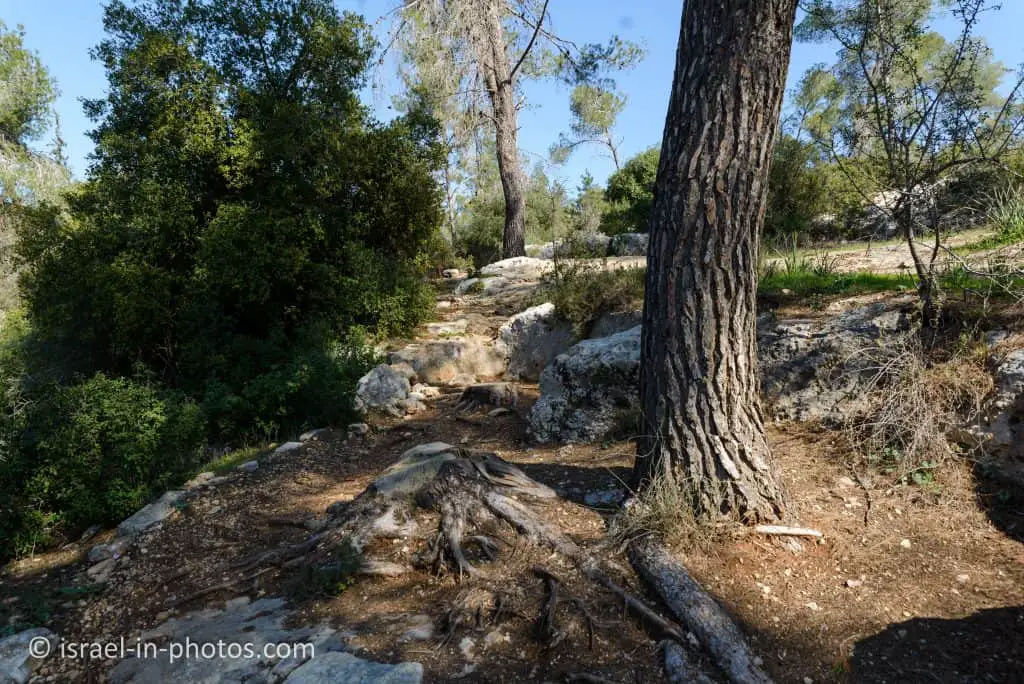
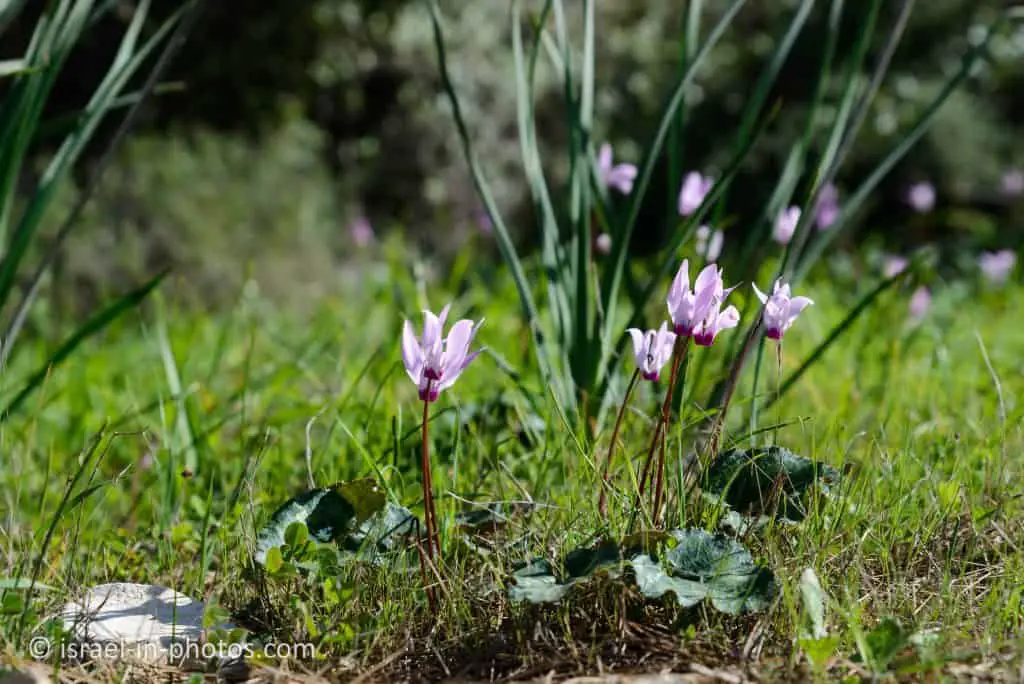
We started hiking uphill on the red trail towards the Roman stairs. Here are several photos from that section of the route:
Roman Milestone
After about twelve minutes, we saw columns.
On the right side of the path, there are four fragments of round rock pillars. These are the remains of the Roman millstones. Millstones were placed on the roadsides of the Roman Empire and indicated the distance from the start of the road, usually from a major city. The empire rulers often took advantage of the millstones and wrote dedicatory inscriptions that strengthened their status. For the most part, the rulers left their predecessors’ millstones, so there could be several millstones in one place.
Source: KKL


Note: you can see a preserved Roman Milestone near The Mizgaga Museum.
Here are several additional photos of the path:


