

Makhtesh Ramon Visitors Center, Mitzpe Ramon – Visitors Guide

Makhtesh Ramon Visitors Center in Mitzpe Ramon tells the story of the first Israeli astronaut and the Ramon crater.
Note: you can find additional information at Mitzpe Ramon and Makhtesh Ramon.
Map
Mitzpe Ramon is a small town in the Negev desert, around 80 km south of Beer Sheva. Mitzpe Ramon is located on the edge of Makhtesh Ramon. And it is a good point to start exploring Makhtesh Ramon. Moreover, Makhtesh Ramon Visitors Center is located in Mitzpe Ramon.
Directions for drivers: Link to Waze and Link to Google Maps
Directions for public transport: Link to Moovit
Interactive map of the area:
Here is a more detailed map from the brochure provided at the visitor’s center.
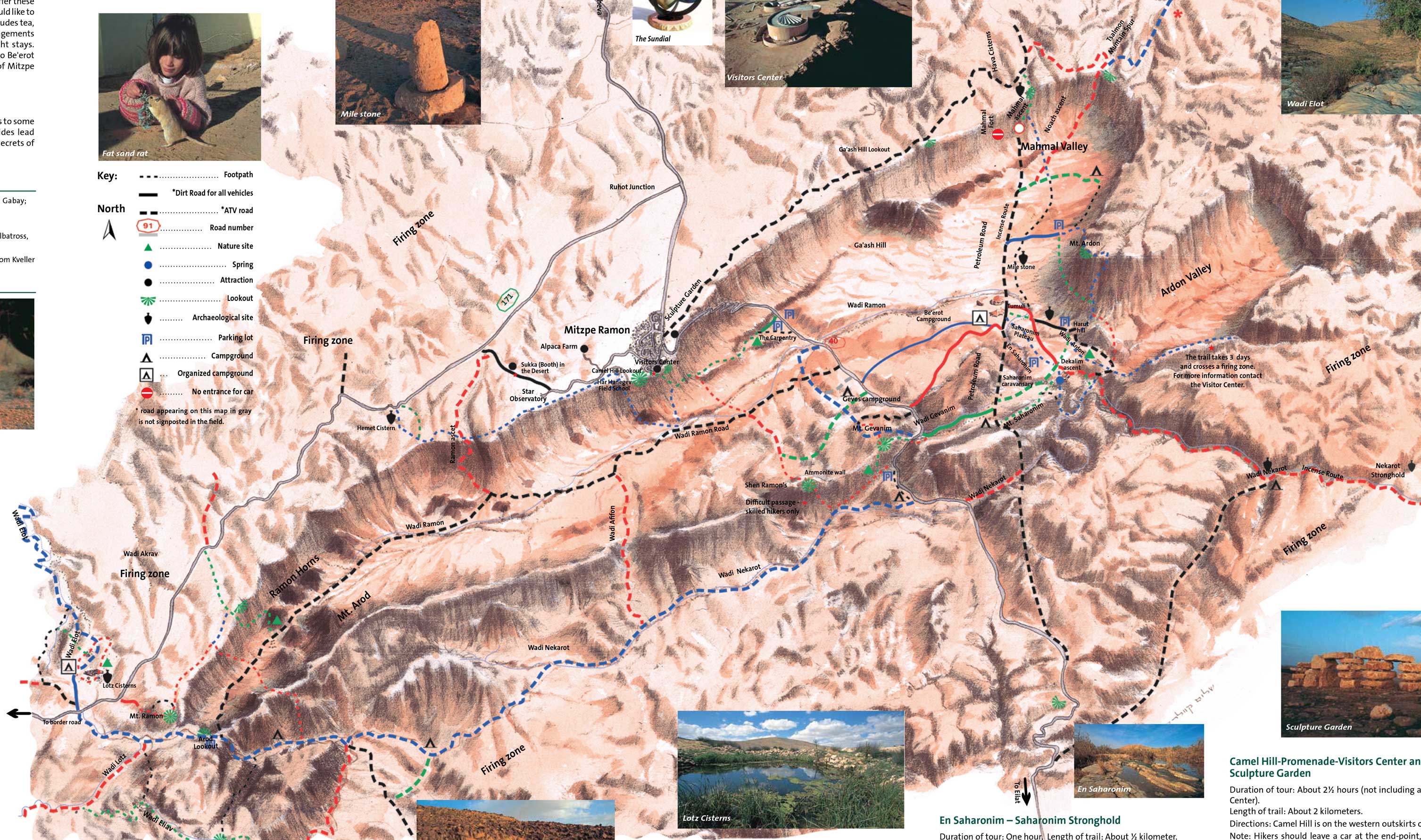
Note: you can click on the map to enlarge it.
Parking
You can find a free parking lot near Makhtesh Ramon Visitors Center.
Our latest visit was early in the morning. And since it was quite chilly, a dozen Nubian Ibexes lay on the ground and warmed up in the sun’s rays.


Nubian Ibexes come to Mitzpe Ramon in search of food. They open garbage cans and eat whatever they find. It is common to see Nubian Ibexes on the streets of Mitzpe Ramon. So, drive slower than usual.
Here is a photo of Nubian Ibexes warming up and the “balcony viewpoint” in the background.

An important tip regarding parking, though my first instinct is to park in shaded areas, do not park the car near or under trees. Nubian Ibexes tend to climb on top of cars and use them as a step to reach the tree’s leaves.
Opening Hours
Sunday – Thursday and Saturday: 8:00 – 17:00 (16:00 in winter).
Friday: 8:00 – 16:00 (15:00 in winter).
On holiday eves, usually 8:00 – 13:00.
Note: Since the pandemic, the Israel Nature and Parks Authority has started limiting the number of people in each park. Thus, reservations are recommended through the official site (you can find the link below).
Entrance Fee
Adult – 28 NIS, child – 14 NIS, and student – 24 NIS. Free for National Parks annual subscribers.
If you visit several National Parks, consider purchasing a combo ticket. For additional information, see National Parks and Nature Reserves.
Note: opening hours and ticket prices were updated in March 2023. In any case, recheck the official site before visiting.

Contact Information
Phone: 08-6588691
Email: mm.ramon@npa.org.il
Colonel Ilan Ramon
My previous visit to Makhtesh Ramon Visitors Center was about a decade ago, and since then, it was expanded significantly.

An entirely new section in memory of Colonel Ilan Ramon was constructed.

Colonel Ilan Ramon was an Israeli Air Force pilot who became the first Israeli astronaut. He joined the NASA Columbia mission (in 2003). Unfortunately, he and six other crew members were killed in the re-entry accident.

Ramon is the only foreign recipient of the United States Congressional Space Medal of Honor.
We took a lift to the second floor from the first floor, where we saw the shuttle model. There we saw a short movie about Ilan Ramon.

This story becomes even sadder when in 2009 when Assaf, Ilan’s eldest son, died during a routine training flight (he also joined IAF (Israeli Air Force) and was an F-16 pilot).
When the movie ended, the shutters opened, and you could see the beauty of Makhtesh Ramon:

What is the connection between Ilan Ramon and Makhtesh Ramon? Ilan’s original family name was Wolferman. But, when he joined IAF (Israeli Air Force), he changed his last name to Ramon. Many people changed their last names to Hebrew names in those years, and Ilan loved the Ramon area, thus the selection.

Geology
The next exhibitions tell the story of Makhtesh Ramon. And it starts with geology.
The Makhteshim, looking like enormous basins opened up among the Negev ranges, is a unique natural phenomenon in the world. The 40-km long Makhtesh Ramon is the largest and most impressive, and visitors are provided a glimpse of the magic and secrets of the desert.
Note: unless stated otherwise, all quotes were taken from the official site.
We went to an area where the geology of Makhtesh Ramon is explained.
They were formed by a long process lasting millions of years, including rock sedimentation, folding, and weathering. At first soft layers of land rock sediment, such as sandstone, were formed. After the sea flooded the region, harder marine rock sediments were formed above them, such as limestone. An ancient geological fault caused the rock layers to buckle and fold, creating an anticline. At the same time, the ocean still covered the region.
The rise of the anticline and retreat of the water caused the anticline to be exposed as an “island” in the sea. The hard upper layers of rock began to erode, revealing the soft layers underneath them. Subsequently, a system of large streams flowing westward left alluvium consisting of pebbles and more sandstone. At a later stage, the anticline rose again, asymmetrically, inclining eastward to the Arava due to the Great Rift Valley movement. The river flowing on the ridge eastward eroded the soft layers of sandstone. The lift and incline enabled the sand layers at the heart of the anticline to empty quickly, thus creating the Makhtesh: a valley surrounded by tall cliffs, usually drained by a single stream.

Then we saw a short movie explaining the geological process. A video was projected on a 3D model that continually changed its form. Here you can see the explanation of how the crater was drained by two rivers (Nahal Ramon and Nahal Ardon).

Some exhibits allow interaction, like finding Ammonite (see: Ammonite Wall in Ramon Crater). Kids can operate the handles and “excavate” the Ammonite.

Fauna
The last part of our tour presented a short movie about the flora and fauna of the Makhtesh.
We already saw Nubian Ibex next to the visitors center, but there are also other species. For example, Dorcas Gazelle, Arabian Leopard, Wild Ass, predators, and reptiles. And here, you can see a family of owls.

Makhtesh Ramon has a broad range of rocks, soil, and climate. All these create a wide variety of conditions and plant biomes in a small geographic area and enable many animals to find the best environment for them. The cliffs of the Makhtesh, its mountainous slopes, the beds of the streams, the springs in the oases, and the sandy regions are all unique habitats, each containing different species of reptiles, mammals, and birds. The special conditions in the desert, particularly the lack of water and the extreme temperatures, have forced the animals to develop specific traits with the help they manage to survive and multiply. Due to the heavy heat prevailing in the desert during the day, we do not usually meet the animals themselves while walking in reserve, but we can find many signs testifying to their existence and activity
What Animals Can Be Found in Makhtesh Ramon?
Nubian Ibex, Dorcas Gazelle, And Wild Ass
The Nubian Ibex (Capra Nubiana) – a herbivore mammal very well adapted to life on mountains and cliffs. The ibex live in separate male and female herds, and the males have impressive curved horns. When the State of Israel was established, ibex in Israel were a threatened species. However, preservation efforts led to their rehabilitation, and they are presently widespread in the Judean and Negev deserts. Due to the efforts to preserve the ibex, Nature and Parks Authority chose that animal as its symbol. Ibex live in the vicinity of human habitation. They are habituated to humans and are not deterred by their proximity. It is important not to feed the ibex, as human food leftovers might be harmful to their health.
The Dorcas Gazelle (Gazella Dorcas) is a herbivore mammal living in herds in desert regions. Due to uncontrolled hunting, the Dorcas gazelle became extinct in most of its habitats in the world. In Israel, populations are living in the Arava and the southern Negev.
The Wild Ass – this animal disappeared from Israel at the beginning of the 20th century. In 1982 Asian wild asses (Equus hemionus) were released into Makhtesh Ramon, and due to natural increase, and the release of more of these animals, their population has grown, and their numbers are presently estimated at 250-300 individuals living in the Makhtesh Ramon and Borot Lots.
Note: if you want to find additional info about animals and wildlife, then check out Zoos and Aquariums in Israel.