

Agamon Hula – Must For Bird Lovers – Visitors Guide

Agamon Hula is a wetland habitat in northern Israel. And during each migration season, millions of birds fly over the Hula Valley. Hence, it is the perfect place for bird watching.
Note: For additional info about animals and wildlife, check out Zoos and Aquariums in Israel.
Note 2: There is a common mix-up between Hula Nature Reserve and Agamon Hula. These are two different places, which are both located in the Hula Valley. Сheck out Agamon Hula versus Hula Nature Reserve – Which one is Better? for a comparison of the two places.
I visited Agamon Hula more than a dozen times, and this post contains my impressions and photos from some of those visits. Before we start with basic info, I want to share two important tips. First of all, visit only during the migration season. And secondly, if you can, join one of the tours.
Map
Agamon Hula is located 15 km south of Kiryat Shmona. It is also near Hula Nature Reserve. On the following map, you can see Agamon Hula to the north and Hula Nature Reserve to the south.
Directions for drivers: Link to Waze and Link to Google Maps
Directions for public transport: Link to Moovit
Interactive map of the area:
And here is a map of Agamon Hula:

Trails
The length of the trail at Agamon Hula is 9.5 km, and it is marked in red on the map below.
Here is an interactive map from israelhiking.osm.org.il:
Directions
You can reach Agamon Hula either by car or by bus. If you arrive by car, enter “Agamon Hula” into your navigation app. And if you choose public transport, you can see directions at Moovit. Follow this link and enter your starting point to get the updated instructions.
Opening Hours
Sunday – Thursday: 08:00 – 19:00
Friday and Saturday: 06:30 – 19:00
Note: you can enter the site until 17:30.
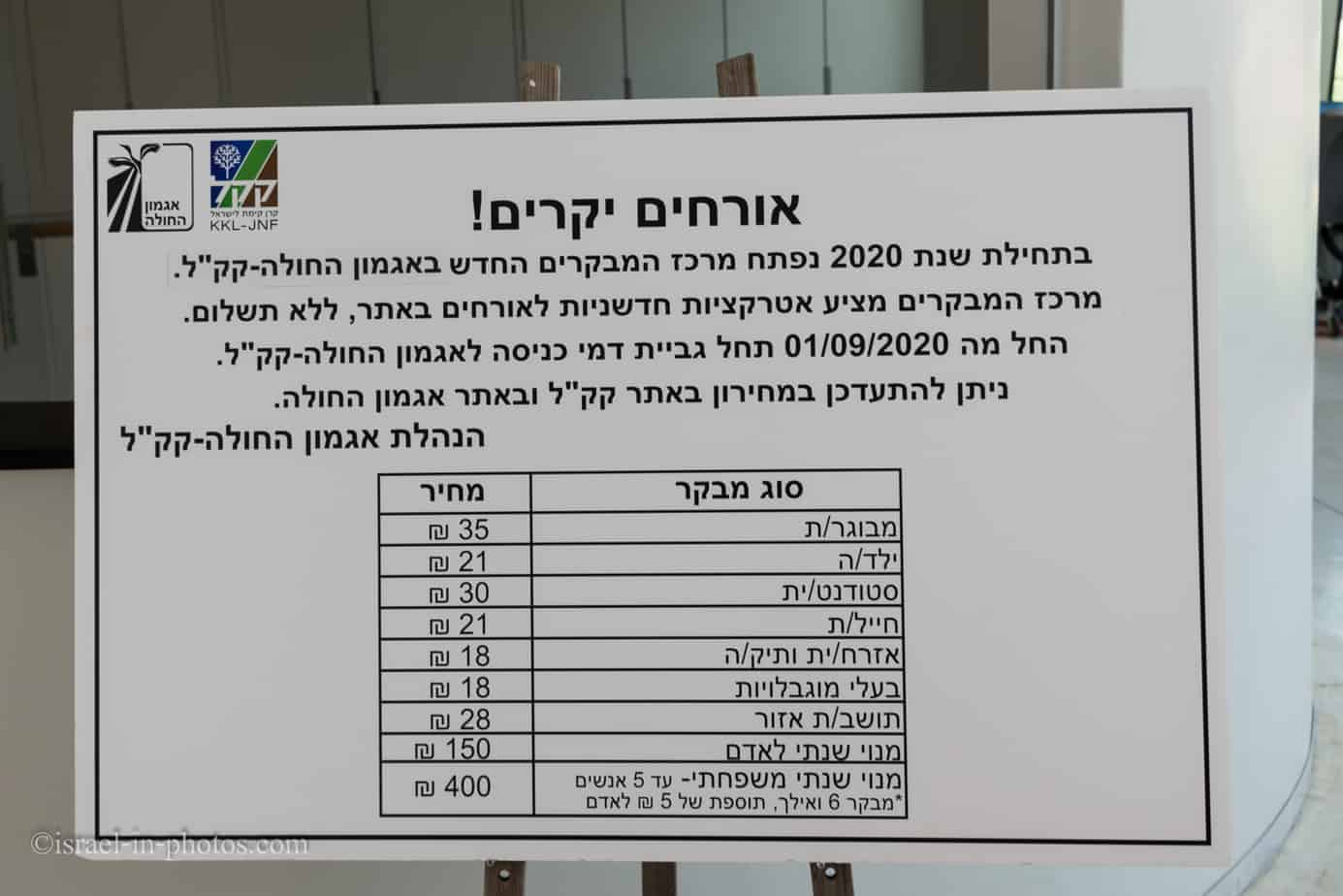
Entrance Fee
Agamon Hula is much bigger than Hula Nature Reserve, and the round trail is around 9.5 km (see the map above). Thus, you have several options to complete the path. You can walk, rent a bicycle, rent a golf cart, or join a tour.
| Price (NIS) | Notes | |
| Entrance – Adult | 35 | |
| Entrance – Child (5 – 18 years old) | 21 | |
| Entrance – Student | 30 | |
| A bicycle per adult | 50 | Rental time is limited to three hours. |
| A bicycle per child | 42 | Rental time is limited to three hours. |
| Golf Cart for two people | 149 | Rental time is limited to 75 minutes. |
| Golf Cart for four people | 199 | Rental time is limited to 75 minutes. |
| Golf Cart for six people | 259 | Rental time is limited to 75 minutes. |
| Sunrise Tour | 85 NIS per adult and 65 NIS per child (3-12) | Duration: two hours. You have to register in advance. |
| Night Tour | 85 NIS per adult and 65 NIS per child (3-12) | Duration: 1.5 hours. You have to register in advance. |
| Safari Wagon Tour | 59 NIS per adult and 51 NIS per child (3-12) | Duration: one hour. You have to register in advance. You can do this on-site. |
| Sunset Tour | 64 NIS per adult and 55 NIS per child (3-12) | Duration: 1.5 hours. You have to register in advance. |
| Renting binoculars and a guide | 20 |
Note: during the peak season (migration peak), they might run out of Golf Carts and Bicycles. Thus, I would suggest coming early.
These are the most popular options, but there are several others. For the complete list, visit the official site.
Note: Opening hours and entrance fees were updated in April 2021. In any case, recheck the official site before visiting.
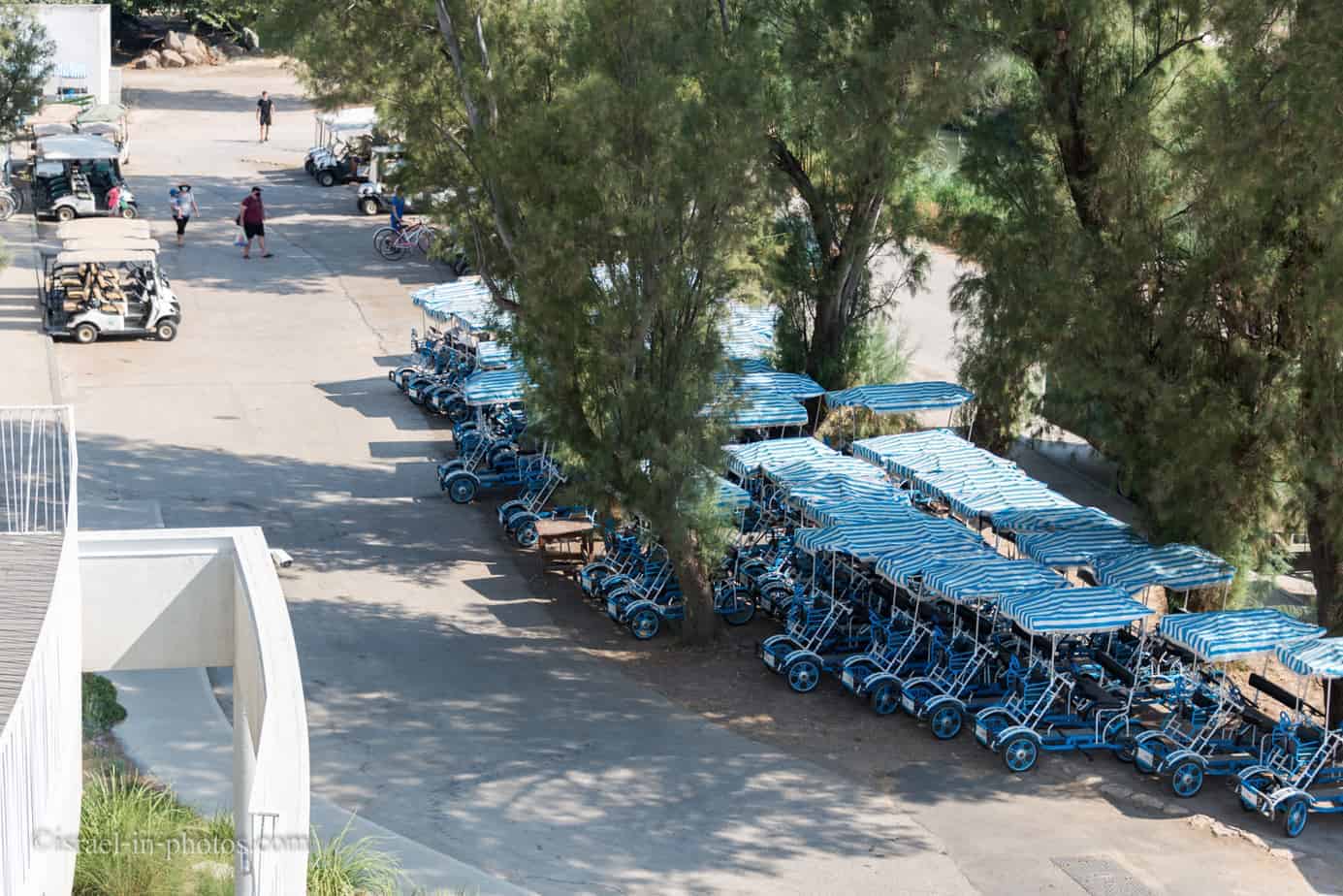
If you visit on a regular day (not a holiday or on the weekend), you can bring your bicycle. In that case, you will pay only the entrance fee mentioned above. Also, if you decide to walk, you will spend the same amount.
What is the Best Time to Visit Hula Valley?
The best time for a visit is during bird migration, which means either fall or spring (usually March – April and October – November). If you want to know the exact dates and what birds are currently there, follow Agamon on social media (here is a link to their Facebook page).
The best time of day is either early in the morning or late afternoon (towards sunset). During these hours, the cranes (and many other species of birds), like most wildlife, are most active. That is also why they offer sunrise and sunset tours.
Visitor Center
Towards the end of 2020, a new visitor center was opened.

But when we came for a visit in August 2020, all the attractions inside the visitor center were closed due to the Coronavirus.
One compelling feature of this building is the viewpoint on top of it. You can either walk up the stairs or take an elevator. And though it is a lovely idea, this viewpoint does not provide exceptional views.
Agamon Hula With Kids
On most visits, we took our kids with us (the only times we traveled alone were when I knew I wanted to stay longer and take more photos). Many people do the same, and there are plenty of kids there. It is a family attraction, and you should not be afraid to take children.
Tours At Agamon
Tour Languages
On all the tours I joined (Safari Wagon tours and Sunrise tours), the guide gave explanations in Hebrew. If you are interested in tours in another language, I would suggest contacting Agamon either by using the contact form on the official site or by phone at +972-4-6817137.
Safari Wagon
During my first several visits to Agamon, I cycled. But the problem is that you cannot get too close to birds and see them from a distance. Thus, after several regular visits, I started to join the Safari Wagon tour.
While on-site, you register and pay for a Safari Wagon tour. And then you will need to wait (usually up to half an hour) for the beginning.

Usually, birds are afraid of humans and keep their distance. Moreover, it would help if you had binoculars or a long lens to see or photograph them. One way to get around that is by hiding, and another is gaining an animal’s trust.
The safari wagon is a combination. Firstly, you sit in a towed vehicle (by a tractor). Although it is open on one side, you are asked to keep quiet so you will not frighten the birds. Secondly, the same tractors are used to feed the birds. And since birds are used to those tractors, they come close to them. But those tractors supply food primarily for cranes during the migration season. Thus, it is less likely that you will see other birds from such a close distance. Songbirds and pray birds will keep their distance from the safari wagon.
Another critical factor is that the safari wagon enters areas you can not enter by foot or bicycle.
The duration of a safari wagon is about 40-60 minutes. And if you want an even better experience, I suggest the Sunrise Tour. These tours are also done in safari wagons, but they are made during sunrise, which is a magical time (not only in photography but also when the birds wake up and fly for breakfast).
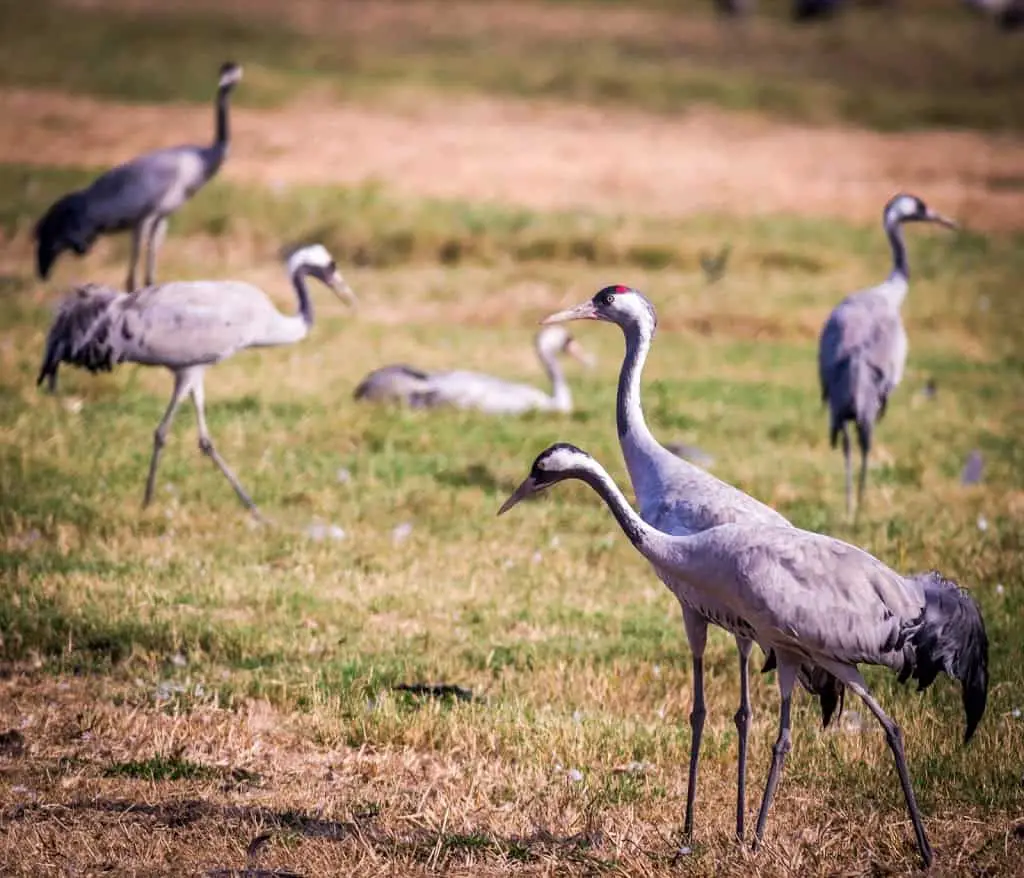
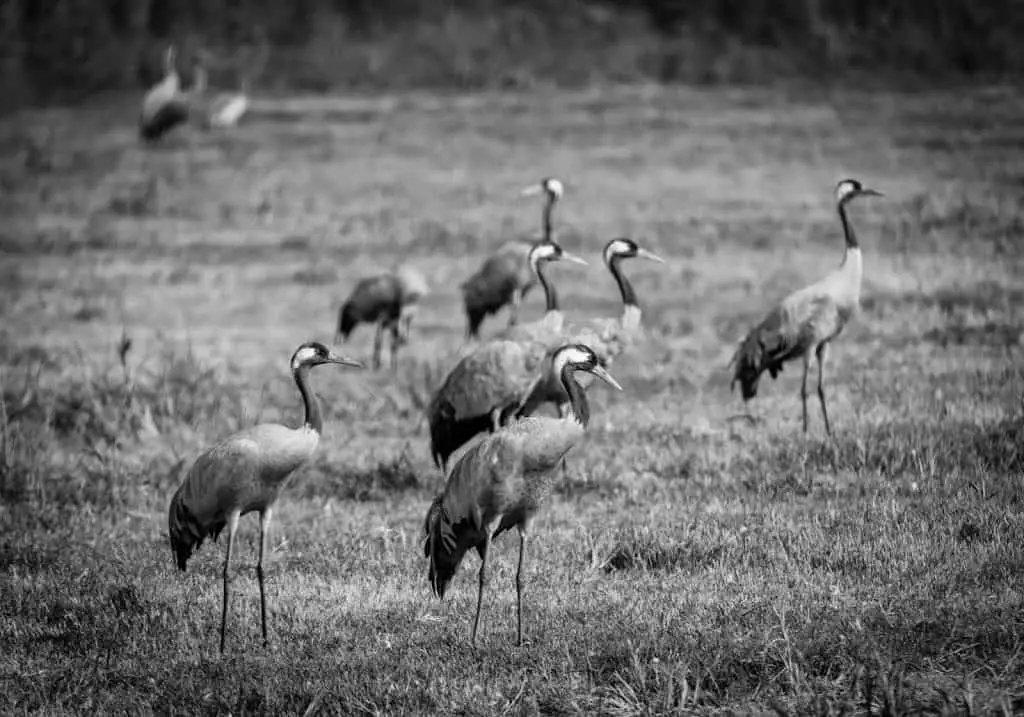
Here are several of my shots from Safari Wagons.
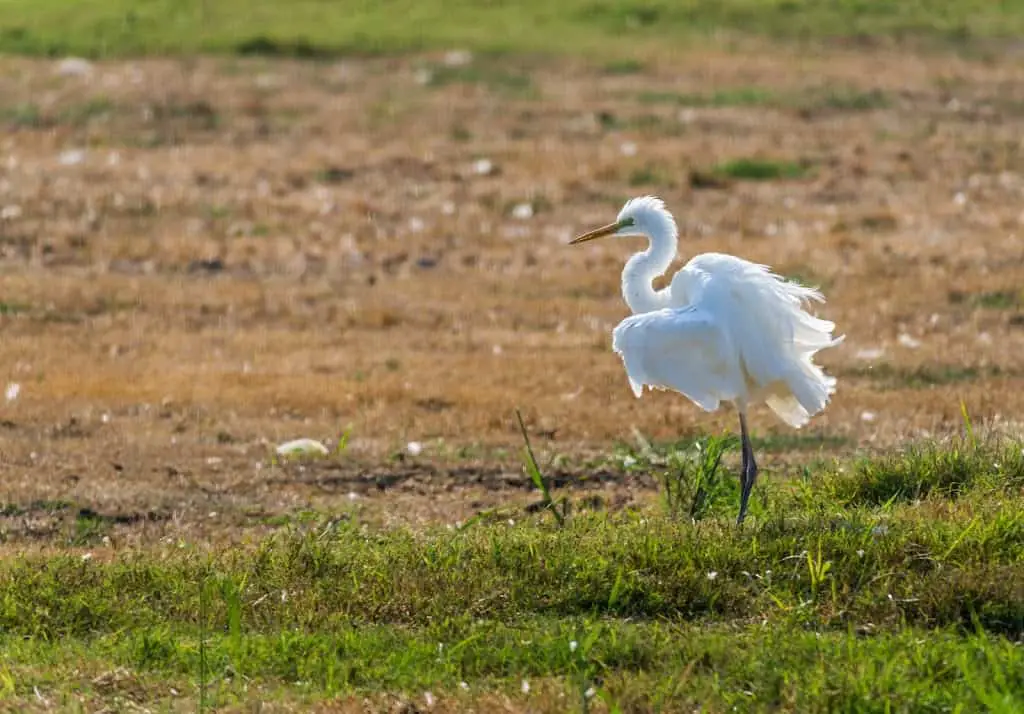




You can find Nutrias in Agamon and Ein Afek Nature Reserve, and I wrote about their history in Israel at Nutria (Coypu).
The Sunrise Tour
At the top of this post, you saw a short video from the Agamon Hula sunrise tour. You can see about 50,000 cranes in the video, which is still not the peak.
Two exciting and less familiar facts about cranes:
- In the video, you can see that while some cranes were eating, others were on guard. You can never see all cranes with their heads down.
- Cranes, similarly to swans, also have one partner per life. Moreover, they renew their “marriage vows” each year by performing their mating dances.
You need to sign up in advance for the sunrise tour. Preferably several weeks in advance during the peak season.